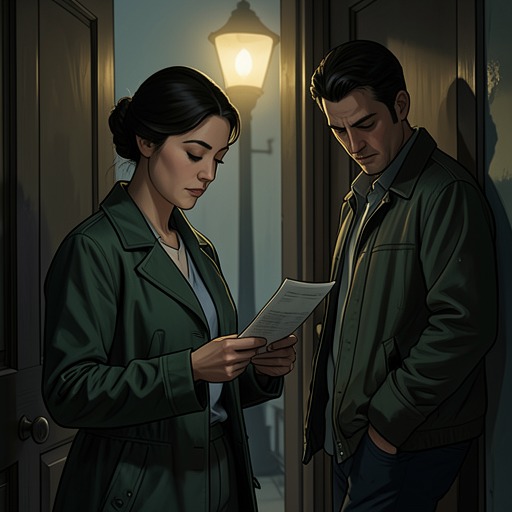
Takaki’s lost letter to Akari
5 Centimeters per SecondTakaki Tohno’s lost letter to Akari Shinohara is both a carefully composed first love letter and a message that never reaches its intended reader. Written before Takaki Tohno moves to Kagoshima, it gathers his hopes, tastes, and feelings into a record of the person he is at that moment. He carries it toward a meeting with Akari Shinohara through a snowstorm, but a gust takes it from his hands at the station. Years or stages of life later, a dream returns him to the act of writing and gives the letter’s final page a question about what it means to become an adult.
Identity and Purpose
The letter begins as part of Takaki Tohno’s effort to see Akari Shinohara before his move. Their schedules leave only an evening at the end of the school term: he plans to leave after class, meet her at the station near her home at seven, talk for a couple of hours, and take the last train back. The visit matters enough that he works out a long route across several lines and accepts a round-trip fare of about 3,500 yen, a substantial expense for a middle-school student. The letter gives that anticipated meeting another form. It is something he can prepare in advance and place in Akari Shinohara’s hands, carrying what an evening together might not have time to hold.
Takaki Tohno spends the two weeks before the rendezvous composing it. He regards it as probably the first love letter he has written. Its contents range beyond a simple declaration: he writes about the future he dreams of, books and music that have influenced him, and how special Akari Shinohara is to him. He later admits that he cannot remember the precise details, but estimates that the letter filled about eight sheets of stationery. Its scale reflects how much he wants to communicate, not merely the fact that he loves her.
What the Letter Contains
Takaki Tohno describes his expression as artless and childish, yet says he wrote as honestly as he could. That contrast is central to the letter’s purpose: it is not presented as polished persuasion, but as an attempt to make his feelings and his present self available to Akari Shinohara. He thinks that if she reads it, he will be able to endure the move to Kagoshima. The letter thus becomes an imagined link across a separation that has not yet begun, an object entrusted with more than the words on its pages.
In retrospect, he calls the letter a collection of fragments of his current self that he wanted Akari Shinohara to have. The description makes its intended value personal and temporal. It records what he cares about and who he hopes to become at the point when their shared daily life is about to change. At the same time, Takaki Tohno later recognizes that the letter was only one among many things shaping their lives, and that even his intense feelings would have changed over time whether or not he had delivered it. The object matters deeply to him without being treated as capable of fixing the future.
The Snowbound Journey and Loss
On the day of their meeting, Takaki Tohno carries the letter with him through a journey delayed by heavy snow. At the Ryomo Line platform, he waits in a bare concrete passage-like space, with cement pillars, exposed pipes, closed kiosk shutters, and the low sound of the storm. An announcement reports significant delays. Cold, anxiety about keeping Akari Shinohara waiting, and a stabbing pain in his stomach leave him tense. He considers buying food but worries that she may be hungry while she waits; instead, he decides to get a hot can of coffee.
As he takes his wallet from his coat, the letter falls out. A gust of wind immediately snatches it away, carrying it off the platform and into the dark. Takaki Tohno nearly bursts into tears, then looks down, grits his teeth, and holds them back. He does not buy the coffee. The loss takes place amid practical discomfort and mounting delay, not in a quiet moment set apart for farewell: the letter disappears just as he is trying to manage the ordinary demands of waiting and traveling.
The train later stops in the snow about halfway to its destination, with no estimated time for service to resume. By then, two hours have passed since the agreed meeting time. Takaki Tohno removes his watch and sets it on the small table by the window rather than continue watching time pass. The letter’s disappearance precedes this further frustration, and the journey exposes the distance between the message he prepared and the meeting he is trying to reach. In retrospect, he doubts that delivering the letter would necessarily have changed much. That qualification does not erase the loss; it places the lost object within a longer life whose course could not be determined by a single exchange.
The Letter’s Return in a Dream
In a later dream, Takaki Tohno is again in his room in Setagaya, now filled with boxes for the move, writing a letter for the girl he likes. The dream identifies it as the letter that will be blown away and never reach her. Unlike the younger writer anticipating a meeting, the dreamer knows the outcome in advance. He nevertheless feels that he has to write it, even if nobody ever sees it, and understands the act as something he needs to do for himself.
The dream brings the letter back not as a recovered object but as a renewed act of writing. On the very last sheet of stationery, Takaki Tohno writes that he still does not really know what becoming an adult means, then imagines meeting Akari Shinohara again somewhere in the distant future and wanting to be proud of who he has become. The ending shifts the letter’s horizon: its first purpose was to reach Akari Shinohara before the move, while the dream’s final page turns toward an uncertain future and the possibility of reunion. The text does not claim that the lost letter was found or delivered; its return occurs in the dream.
Narrative Significance
The letter’s history is shaped by a tension between expression and transmission. Takaki Tohno can write at length, filling about eight pages with things he wants Akari Shinohara to know, but he cannot control whether the pages reach her. The wind’s abrupt intervention makes that failure concrete. His later reflection resists making the lost letter the sole cause of what follows: even if he had handed it over, he believes time would still have changed their feelings. The object is therefore neither a guaranteed bridge nor a meaningless scrap. It holds a particular version of Takaki Tohno’s hopes, while its absence marks the limits of what he can send ahead of himself.
The dream intensifies that meaning by separating the knowledge of loss from the need to write. Takaki Tohno knows the letter will vanish and writes anyway, ending not with a demand for an answer but with uncertainty about adulthood and a wish to face a possible future reunion with pride. The lost letter consequently remains an unfinished communication in the story and, in the dream, becomes a private act of self-address: words meant for Akari Shinohara also help Takaki Tohno articulate what he wants from the person he may become.